

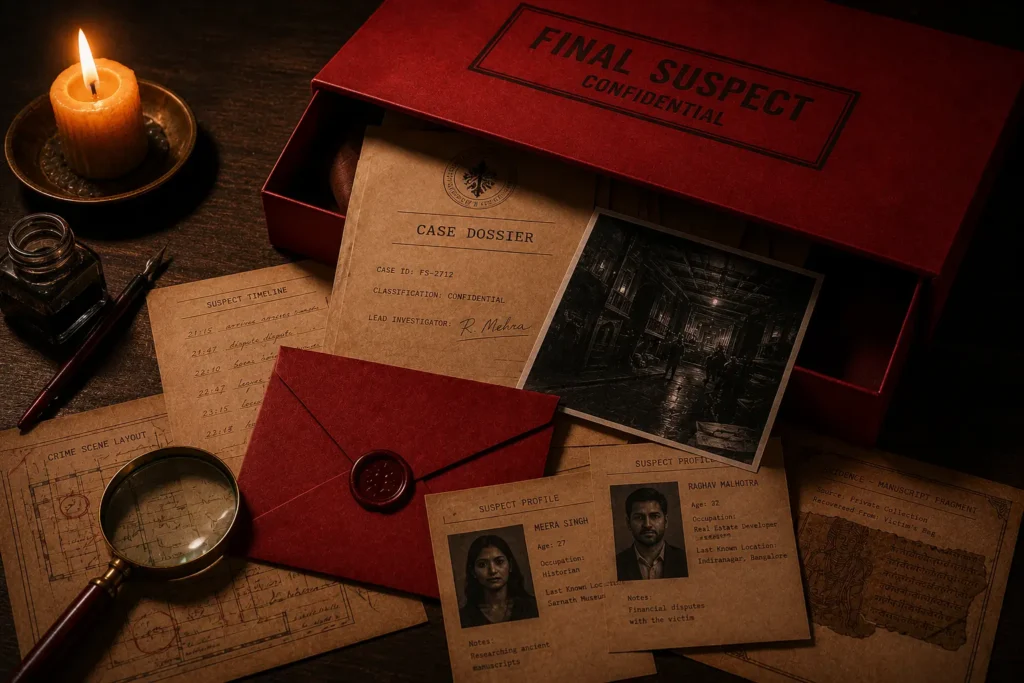

A murder mystery game kit contains a case dossier, suspect profile cards, physical evidence documents, hidden clues, newspaper clippings, and a sealed solution envelope. Every item is there for a reason. Nothing is filler. This guide breaks down exactly what you get inside a FinalSuspect kit – piece by piece – and explains why each item matters to the investigation. All kits are ₹997 with free shipping and COD across India.
Most people who buy a murder mystery kit for the first time have the same question before ordering.
“But what’s actually in the box?”
It’s a fair question. You’re spending ₹997. You want to know whether you’re getting a proper investigation experience or a thin collection of cards that runs out of content in forty minutes.
The answer depends entirely on who built the kit and how seriously they took the evidence design.
When you open a well-made kit, it feels like you’re opening a real case file. Real-looking paper documents. Pictures that have real information in them. Suspect files where the alibis almost work, but not quite. Everything is connected to something else. There is nothing there by chance.
A poorly made kit feels like a crime-themed party game. Clues that aren’t very clear. Common suspects. A solution that doesn’t make sense based on the evidence. People who have bought cheap marketplace kits know how this feels: the Amazon reviews say “loop holes everywhere” and “didn’t provide enough evidence to actually solve it.”
This guide tells you what FinalSuspect puts in each kit and why each item is there. This is all the information you need to make a decision about whether or not to buy.
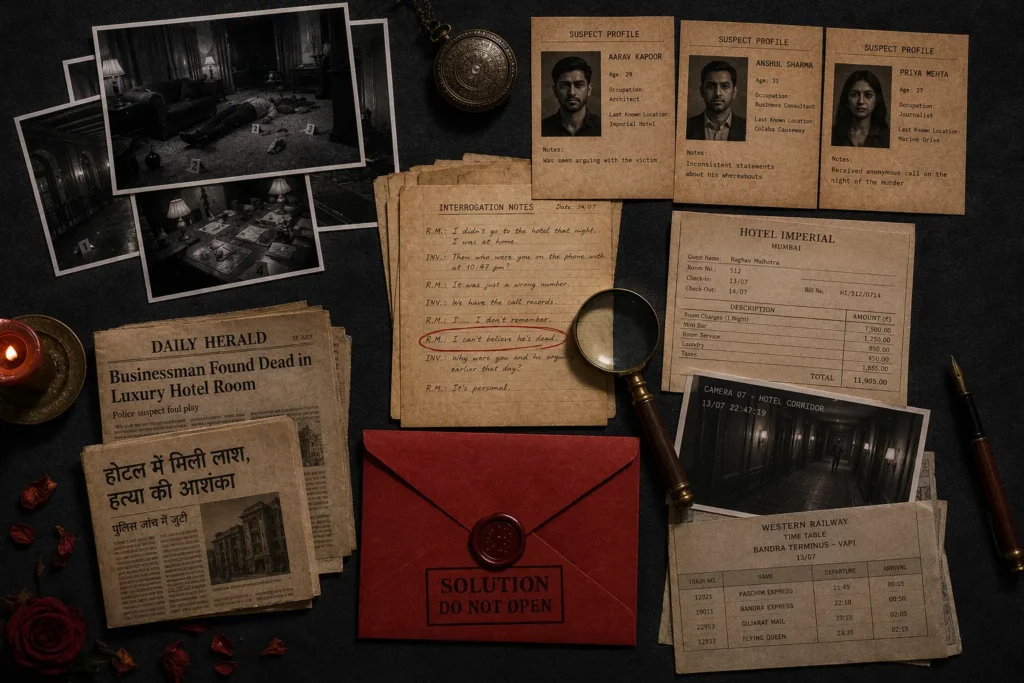
A quality murder mystery game kit contains a complete case dossier, suspect profile cards, physical evidence documents, layered clues, newspaper clippings, and a sealed solution envelope. Every item carries information the killer tried to hide.
That’s the short answer.
Here’s the full breakdown.
This is where everything starts.
The case dossier is your briefing document. It covers the crime, the victim, the timeline, and the setting. You read this before you touch anything else in the box.
In The Silent Express, the dossier drops you into 1930s colonial India. A luxury train. A sealed first-class cabin. A dead body discovered before the train reaches Bombay. The dossier tells you who the victim is, what the initial scene looked like, and who was on board. It sets the frame for every piece of evidence that follows.
In The Neighbours, the dossier introduces you as Detective Anshul Sharma, called to investigate the suspicious death of architect Aarav Kapoor in a quiet residential society. Contemporary setting. Five suspects. Three separate objectives to crack before you can name the killer.
The dossier isn’t just backstory. It’s your first piece of evidence. Details in the briefing matter later. Read it carefully.
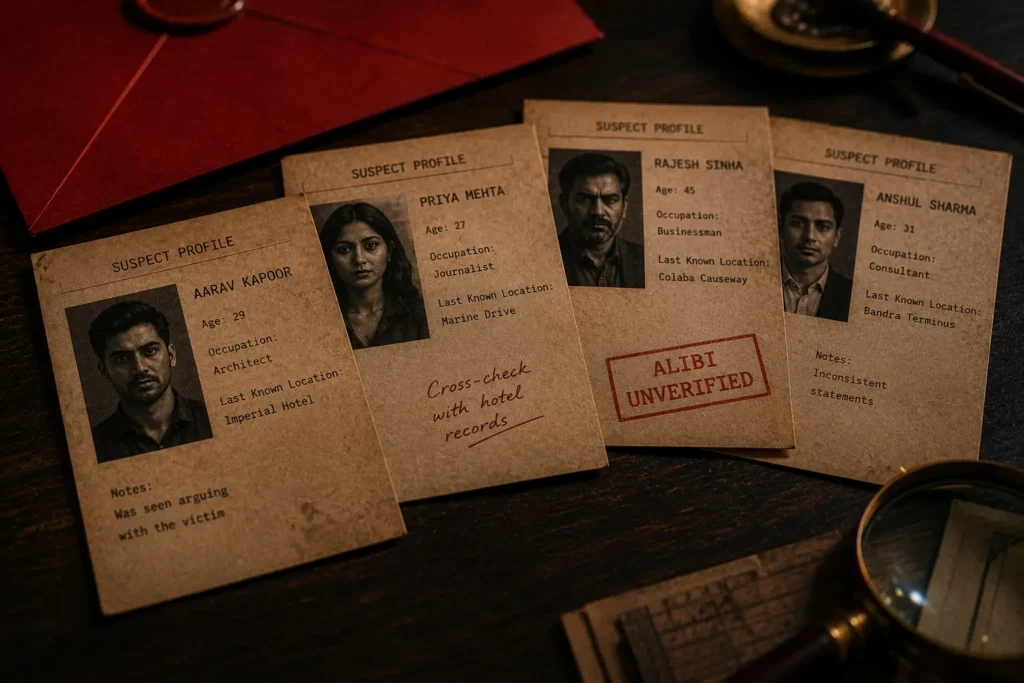
Every kit includes a full set of suspect profile cards – one for each person who had motive, means, or opportunity.
Each card covers background information, stated alibi, known relationship to the victim, and behavioral notes from the initial investigation. Somebody in that stack is lying. Your job is finding where their story breaks down.
The profiles are designed with specific contradictions built in. One suspect’s alibi depends on a timeline that doesn’t match the physical evidence. Another’s stated location conflicts with a document that surfaces later. You won’t catch these contradictions on the first read. That’s intentional.
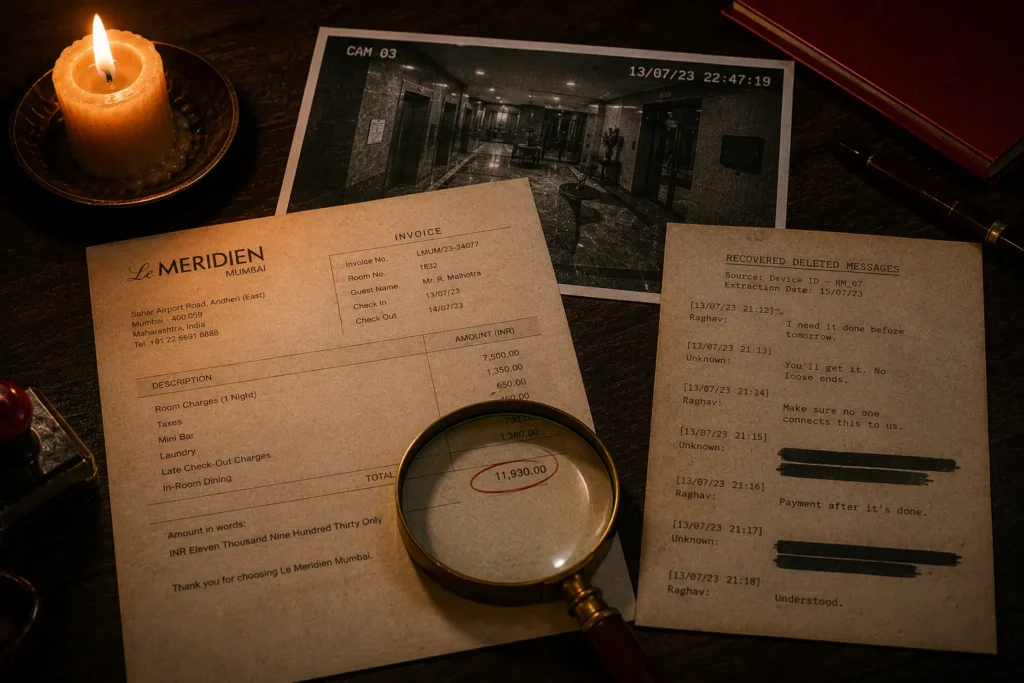
In The Neighbours, you’re cross-referencing five suspect profiles against CCTV records, a hotel bill, and deleted text transcripts. The contradiction that cracks the case is subtle. First-time players almost always miss it on the initial pass.
This is where FinalSuspect kits separate from everything else on the market.
Physical evidence documents are the actual materials the killer left behind – or tried to destroy. These aren’t generic prop cards. They’re printed documents designed to look and feel like real investigative materials.
Depending on which kit you open, you’ll find some combination of:
Handwritten interrogation notes. Transcripts from suspect interviews, written in a format that mirrors actual police procedure. Read between the lines. What the suspect didn’t say matters as much as what they did.
Hotel bills and transaction records. Financial paper trails. Someone spent money somewhere they claimed not to be. The receipt is in the envelope.
CCTV printouts. Timestamp data from surveillance footage. In The Neighbours, one CCTV record directly contradicts a suspect’s stated alibi. Finding that contradiction is one of the three objectives.
Deleted text transcripts. Recovered from a device. Someone tried to erase a conversation. They didn’t do it cleanly enough.
Train schedules and travel documents. In The Silent Express, the train timetable matters. When the train stopped, for how long, and who got off – all of it feeds into the timeline reconstruction.
Archival records and library logs. Background documents that establish patterns of behavior. Useful for building motive, not just opportunity.
Every document is printed at quality that makes it feel real. This matters more than it sounds. When you’re holding a handwritten interrogation note under a magnifying glass, looking for the detail that breaks the alibi, the physicality of the evidence changes how you engage with it.
FinalSuspect kits include glossy printed photographs from the crime scene.
These aren’t stock images of generic crime scenes. They’re photographs built specifically for each case, with details embedded that matter to the investigation.
In The Silent Express, the crime scene photographs show the sealed first-class cabin exactly as it was found. The position of objects. What’s present. Importantly, what’s missing. Something in that photograph is wrong. Most players take fifteen minutes to see it.
Look at the photographs the way a forensic examiner would. Not for the obvious. For the inconsistency.
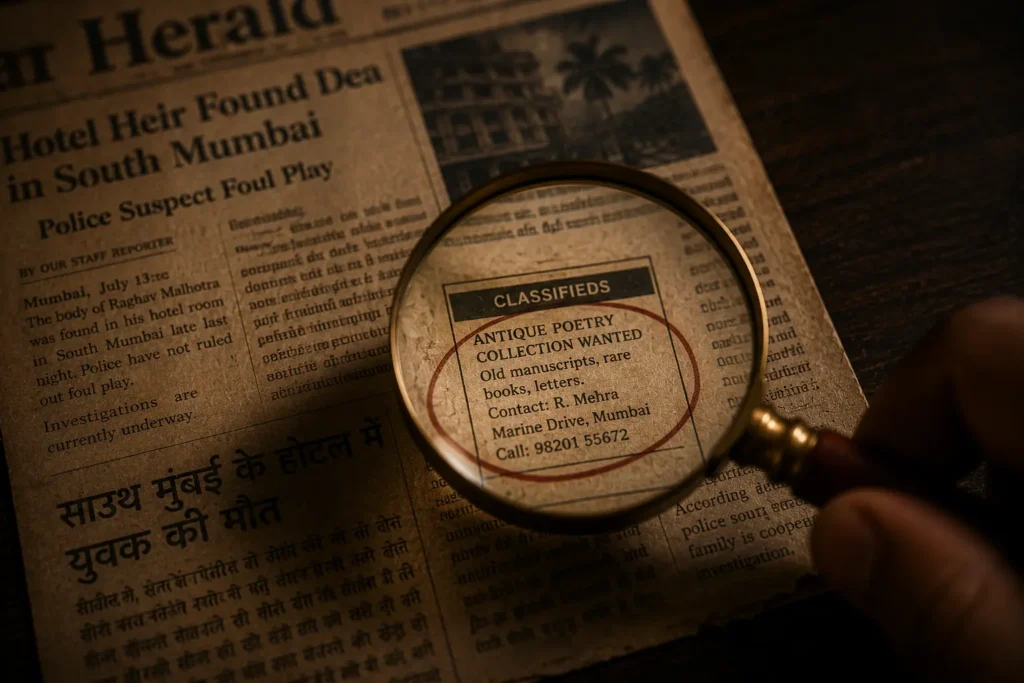
Every kit includes newspaper clippings from the day of the crime.
This is the most underestimated item in the box.
Most players scan the clippings quickly and move on. The headlines look like background texture — period detail, nothing more. That’s exactly what they’re supposed to look like.
The detail that matters is buried. It’s not in the headline. It’s not in the first paragraph. It’s in a byline, a classified section, a small notice on page three that connects to something in the suspect files in a way that only makes sense after you’ve read everything else.
Players who crack FinalSuspect cases faster than average are almost always the ones who went back to the newspaper clippings in the second half of the investigation.
The last item in the box. You don’t open it until your team is ready to commit to an answer.
The solution envelope has the whole case resolution, including who did it, how they did it, and why. It also talks about the evidence chain, which shows how each piece of evidence fits into the bigger picture and what each document proved.
You ruin the experience if you open it too soon. Most players feel the urge to give up when they’re stuck around the 45-minute mark. Don’t give in. If you go back through the evidence in a systematic way, the breakthrough will almost always happen in the next fifteen minutes.
If you got the answer right, the solution envelope confirms your reasoning step by step. If you got it wrong, it shows you exactly where the case broke – and what you missed. Either way, reading through it after the reveal is one of the best parts of the experience.
Not all murder mystery kits are built the same way.
Generic marketplace kits, like the ones you can find on Amazon for ₹300 to ₹500, don’t always do things the right way. There isn’t much proof. The profiles of the suspects are weak. The connections between the clues are weak enough that more than one suspect could be the right one. If the newspaper clippings do exist, they don’t have any real information.
The end result is a game where you have to guess instead of think. The answer seems random because it is. The kit just told you that the evidence led there.
The way clues are built into a well-designed kit is what makes it different. There is at least one other item in the box that connects to each one. There was a reason for every document to be there: it proves or disproves something. The evidence leads to the answer, not luck or a hint system that holds your hand.
That’s what makes the final reveal feel earned rather than handed to you.
Three kits. Each one built around a completely different setting, suspect set, and evidence type.
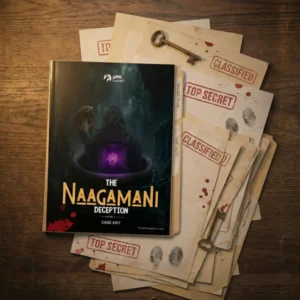
The most accessible kit in the range – forgiving clue structure, maximum thrill rating, runs 1 to 2 hours. Best first kit for beginners, couples, and mixed groups.
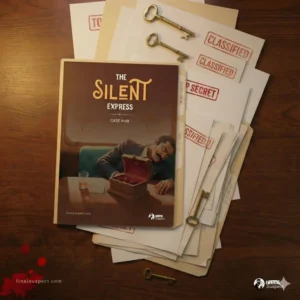
A sealed train cabin, a dead body, a killer hiding behind a perfect alibi. The physical evidence – glossy crime scene photography, archival train documents, handwritten interrogation notes – makes this the most immersive kit in the range. Best for analytical groups and true crime fans.
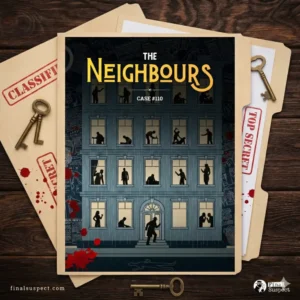
Three objectives. Five suspects. CCTV records, hotel bills, deleted texts. The hardest case in the range. Not a first-kit recommendation – but the most satisfying solve once you’re ready for it.
One kit cost ₹997. Free shipping across India. Dispatched in 24 hours. COD available on every order.
👉 Browse all three kits and pick your first case
The contents of a murder mystery kit are what make it good.
The case file sets the stage. The suspect files tell you who to look for. The proof is in the physical evidence, like papers, pictures, bank statements, and CCTV footage. The newspaper clippings hide the details that most people miss. The envelope with the solution inside is sealed and waits for you.
The items in a FinalSuspect kit all have a specific purpose: to prove or disprove something. That’s the difference between a guess and an investigation.
Over 2,000 investigators across India have opened a FinalSuspect dossier. Most of them immediately ordered a second one.
👉 Order your first kit at ₹997 with free shipping and COD
For a full guide on how everything works together once you start playing, read our complete murder mystery game kit guide. If you’re planning a group evening around your kit, see our murder mystery party hosting guide.
Does a murder mystery kit come with everything or do I need to buy extras?
Every FinalSuspect kit comes with everything it needs. There are case files, suspect profile cards, physical evidence documents, crime scene photos, newspaper clippings, and a sealed envelope with the solution. You don’t have to buy, download, or print anything. Start the investigation by opening the box.
How many pieces of evidence come in a FinalSuspect murder mystery kit?
The number of evidence sources included in each kit varies by case, but they all include suspect files, physical documents, photographs, financial records, and newspaper articles. The Neighbours has the most documents because it has three goals. The Silent Express has the most realistic physical evidence, like glossy crime scene photos and old train documents. Every piece is important to the case.
Can I look at all the evidence at once or do I reveal it in stages?
You can go about it in either way. FinalSuspect kits are made for open evidence play, where everything is available from the start. This is great for analytical groups that want to go through all the materials in a planned way. Some groups like to show evidence in rounds, which makes the session longer and builds tension. Both methods work. The answer stays the same no matter what.
What happens if I lose a piece of evidence in order?
FinalSuspect has a 7-day policy for replacing items. If anything in your kit is missing, broken, or not clear when it arrives, please contact the team directly through the website. The video is mandatory while opening our case for replacement.
Is the physical evidence in FinalSuspect kits reusable?
Yes. After the investigation, all of the evidence documents, suspect cards, photographs, and clippings are still there. Nothing gets eaten or broken during play. You can play the kit again with a new group that hasn’t seen the solution before. The only thing that can’t be resealed after being opened is the sealed envelope. However, the solution text can still be read and used for a group debrief.